
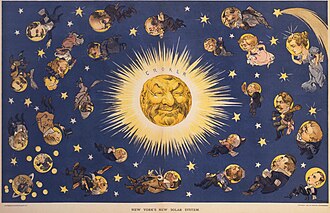
Political machines weren’t some dusty footnote—they were the original power brokers who figured out how to turn urban chaos into a reliable vote-delivery system long before anyone filed a Form 3X with the FEC. These organizations emerged during the explosive growth of 19th-century cities, when immigration and industrialization outpaced any meaningful government safety net. In places like New York, Chicago, Philadelphia, and Boston, a single boss or tight circle could command loyalty by trading jobs, housing help, and food for ballots. Tammany Hall in New York became the textbook case, showing how personal obligation could substitute for formal party infrastructure.
The financial disclosures tell a story the press releases don’t: machines sustained themselves through patronage that looks a lot like today’s earmarks and no-bid contracts, except the paperwork was kept in ward leaders’ pockets rather than on OpenSecrets.org. At the top sat the boss; beneath him stretched a hierarchy of precinct captains who knew exactly how many votes each block could deliver. When the machine won city hall, thousands of government positions flowed to loyalists—no competitive exams, just political IOUs. That system created real economic dependence in neighborhoods the federal government had largely ignored.
The mechanics of machine operations reveal a sophisticated understanding of both human psychology and urban geography. Political machines divided cities into wards, each overseen by a ward leader responsible for turning out votes and maintaining organizational discipline. Below the ward leaders were precinct captains, typically local figures with deep community ties—a bartender, grocer, or shopkeeper who knew every family on their block. These captains maintained detailed voter rolls, tracked which households might be persuadable through favors, and identified which residents faced immediate hardship. When election day arrived, the machine’s ground game operated with military precision: voters were reminded of promised assistance, rides to polling places were arranged, and ballot choices were sometimes—though not always—gently encouraged. This organizational infrastructure made machines extraordinarily effective at turning out votes, often delivering 70 to 80 percent turnout in machine-controlled precincts during peak years.
As a Latina journalist covering Washington accountability, I can’t help but notice the parallels to modern lobbying disclosures. Machines extracted kickbacks from contractors and businesses seeking permits or protection, the same way some contemporary influence operations route money through layered LLCs and 501(c)(4)s. Yet for many poor immigrants, the machine operative who could fix a leaking roof or land a sanitation job felt more tangible than abstract promises of clean government. Corruption—ballot stuffing, vote buying, outright bribery—was baked into the model, but so were the direct services that kept people alive before Social Security or unemployment insurance existed.
The financial ecosystem surrounding political machines operated with remarkable efficiency for its time. A contractor seeking a city paving contract might contribute 2 to 5 percent of the contract value to the machine’s coffers. A business owner needing a liquor license or permit would make a “voluntary contribution” to the local alderman. Saloon keepers paid protection money to avoid harassment. These revenue streams funded not just the machine’s political operations but also the ward clubs, soup kitchens, and bail funds that bound voters to their precinct captains. Boss William O’Dwyer of New York’s Tammany Hall and Richard Daley of Chicago’s machine both perfected this system, creating vast networks where public sector jobs, contracts, and services flowed through political channels rather than market mechanisms or merit-based systems.
The social role machines played in their heyday shouldn’t be understated. Before the New Deal established federal welfare programs, political machines often functioned as de facto social safety nets. A widow whose breadwinner died might receive a job sweeping streets. A family facing eviction could get landlord pressure applied through political channels. Young men without prospects could enter the police or fire departments through political sponsorship. For immigrants arriving in American cities with no language skills, no professional credentials, and no social network, the machine offered a path forward—one that came with strings attached, certainly, but more reliable than the formal economy’s indifference. This explains why machines maintained such fierce loyalty in working-class neighborhoods and why their decline sparked genuine mourning among communities that had depended on them.
Yet the cost of machine politics was substantial and unevenly distributed. Neighborhoods controlled by weaker machines received worse services—fewer streetlights, unpaved roads, inferior schools. Machine-friendly contractors often delivered shoddy work at inflated prices. Honest businesses couldn’t compete with politically connected ones. Talented individuals without political connections faced blocked career paths. The system encouraged corruption at every level and made democratic accountability nearly impossible, since machines could deliver votes regardless of actual policy performance or ethical conduct. By the early 20th century, progressive reformers had documented these costs exhaustively, building public support for structural changes that would eventually dismantle the machines.
The decline came when reformers forced sunlight into the system. Civil service laws replaced patronage with merit exams, cutting off the machine’s primary currency. Federal welfare programs and later television-driven campaigns further eroded the personal relationships that once bound voters to precinct captains. By the late 20th century, even the storied Chicago machine had fractured after Harold Washington’s 1983 victory, while New York’s Tammany and Philadelphia’s organization collapsed under federal prosecutions and demographic shifts. Judicial rulings and expanded civil service protections finished what Progressive Era laws began. The Pendleton Civil Service Reform Act of 1883 marked the beginning of the end, establishing that most federal positions would be filled through competitive examination rather than political appointment. States and cities gradually followed suit, though the pace varied considerably—some political organizations adapted more slowly than others, and rural machines persisted longer than urban ones.
The transition from machine politics to modern campaign infrastructure happened unevenly across the country. Some cities, like New York and Chicago, saw relatively sharp breaks with machine traditions by the 1990s. Others, particularly in the South and parts of the Midwest, maintained elements of machine-style politics well into the modern era, though rebranded and operating under stricter legal constraints. The skills that machine operatives had developed—voter targeting, ground-level organization, personal relationship cultivation—didn’t disappear; they were absorbed into professional campaign consulting, data analytics, and direct mail operations. The emotional appeal of machine politics also endured: candidates continued to promise direct help to constituents, to maintain extensive local offices, and to build personal relationships with voters, even as the formal patronage mechanisms that once sustained machines were dismantled.
The legacy question still matters for anyone tracking campaign finance records today. Some state-level party operations and mayoral networks still rely on personal loyalty webs and targeted favors, though they operate under far stricter contribution limits and disclosure rules than their predecessors. The core tension—efficient service delivery versus concentrated, unaccountable power—hasn’t vanished; it has simply migrated into super PACs, dark-money nonprofits, and the revolving door between city halls and K Street firms. Contemporary political influence operations often employ techniques that echo machine-era tactics: they identify persuadable voters through data analysis rather than personal knowledge, they move resources to favored allies through bundling and super PAC contributions rather than direct patronage, and they cultivate long-term relationships with politicians that ensure favorable treatment on future policy questions.
Understanding how machines rose and fell gives context to current fights over disclosure thresholds and enforcement at the FEC. The same forces that once allowed bosses to dominate city budgets now appear in lobbying reports and bundler lists. History shows that when accountability mechanisms weaken, new versions of old machines tend to reappear—only this time the ledgers are digital and the money moves faster. Recent controversies over anonymous nonprofit donations and undisclosed lobbying activities suggest that the underlying dynamics of concentrated political power and weak accountability remain relevant today. The fundamental lesson from machine politics is that democratic systems require constant attention to transparency, enforcement, and structural incentives that reward accountability over loyalty.