
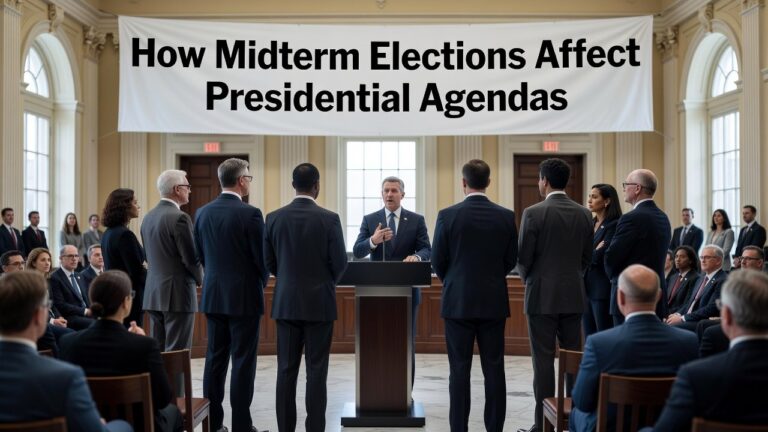
Midterm elections function as a recurring stress test on presidential coalitions, reshaping what remains legislatively viable for the final two years of a term. The data show a remarkably consistent historical pattern: since 1934 the president’s party has lost House seats in 19 of 22 midterms, averaging a 26-seat deficit that redraws the electoral map for the remainder of the cycle.
When you model this electorally, those losses concentrate in suburban and swing districts that tipped the prior presidential map, tightening the path to any future majority. The polling data here paints a complicated picture. Gallup’s historical series shows presidential approval typically falls another seven points in the year after such reversals, driven by differential turnout—core supporters stay home while opposition voters mobilize. That dynamic played out in 1994 when Democrats lost both chambers under Clinton and again in 2010 when Republicans captured the House under Obama, each time forcing the White House to abandon broad initiatives in favor of narrower must-pass measures.
The mechanics of this shift operate at multiple levels simultaneously. First, there is the psychological dimension: a midterm loss signals to the president’s own party that the political climate has shifted, making members of Congress from marginal districts less willing to cast controversial votes heading into the next presidential election. This phenomenon has measurable effects on legislative behavior. Roll call voting patterns tracked by political scientists show increased party-line voting after midterm defeats, as members from safe districts become more ideologically rigid while those in swing districts become more cautious. Simultaneously, the opposition party gains confidence and leverage, knowing they can use procedural tools like the filibuster or amendment processes to slow the president’s remaining agenda.
Presidents adapt by leaning on executive authority. The record indicates a roughly 15 percent rise in executive orders during the two years after a midterm setback, a measurable shift visible across administrations regardless of party. The 2018 results under Trump illustrate the point: once Democrats took the House, further tax or infrastructure packages stalled while oversight activity intensified. Two years later, Biden confronted a narrower Senate margin after 2022, compelling greater reliance on reconciliation and targeted judicial confirmations rather than expansive domestic packages.
This executive pivot reflects both a strategic calculation and a constitutional reality. Executive orders carry real power—they can direct federal agencies to reinterpret existing regulations, redirect spending within executive departments, and establish administrative policy without congressional approval. However, they also carry vulnerability. Courts can overturn executive orders, and they lack the permanence of legislation. A subsequent administration can undo them through the same executive authority. This creates an incentive structure where presidents facing divided government often use executive action as a holding pattern, advancing what they can while laying groundwork for legislative wins if the political environment improves.
Judicial appointments become particularly important in this context. During periods of divided government, the Senate retains the power of confirmation, but the appointment process itself becomes a flashpoint. Presidents may accelerate nomination processes for lower court seats where Democrats and Republicans have found more common ground historically, or focus intensely on Supreme Court nominations if a vacancy exists. The Trump administration’s aggressive judicial appointment strategy during its final two years, when facing Democratic House control, exemplified this approach—with over 230 federal judges appointed by the end of the term, many confirmed during the lame-duck session.
Senate control changes have occurred in 11 midterms since World War II, each time complicating treaty ratification and Supreme Court processes. Yet the same data also reveal pockets of continuity. Bipartisan measures on veterans’ affairs or criminal justice have still advanced under divided government, albeit at rates nearly 40 percent lower than under unified control according to Congressional Research Service tracking. When mapped against demographic turnout models, these successes tend to cluster in states where both parties retain competitive Senate or gubernatorial candidates heading into the next presidential cycle.
The identification of bipartisan legislation patterns reveals important nuance often lost in coverage focused on gridlock. Infrastructure, particularly rural broadband and transportation funding, has proven amenable to bipartisan compromise even under divided government because both parties have members representing rural areas with crumbling infrastructure. Similarly, criminal justice reform—particularly sentencing reform for nonviolent offenses—gained traction under both the Obama and Trump administrations precisely because it appealed to conservatives concerned with government spending and progressives focused on racial justice, creating an unusual coalition.
The political calendar itself matters significantly. Presidents entering the final two years of their term face a fundamentally different strategic landscape depending on whether they anticipate running for reelection or are term-limited. A term-limited president may embrace more ideologically aggressive executive action knowing they will not face electoral consequences, while a president potentially seeking reelection must consider how executive actions will play in the next presidential campaign. Obama’s 2014 midterm losses, followed by executive action on immigration and environmental policy, illustrate this calculation—these actions energized base supporters heading into 2016 but also provided ammunition for opponents.
The 2006 midterms under George W. Bush offer a parallel: Democratic gains shifted emphasis toward war-funding negotiations and away from domestic priorities, foreshadowing the 2008 electoral map. Across these cases, the consistent takeaway is that midterm results do not erase agendas but compress them, requiring presidents to recalibrate around the new congressional geography rather than the one that existed on Election Day two years earlier.
Understanding how midterms reshape presidencies also requires attention to the role of party leadership transitions. A weak midterm performance sometimes precipitates leadership changes in Congress, with new party leaders bringing different priorities and negotiating styles. When Nancy Pelosi initially stepped down from Democratic leadership in 2019 following the 2018 midterms, it signaled potential shifts in how House Democrats would engage with the Trump administration. Similarly, leadership transitions often reset the relationship between the White House and Congress, creating opportunities for new working relationships even within divided government.
The international dimension adds another layer of complexity. Presidents dealing with midterm losses sometimes recalibrate foreign policy to match their reduced domestic capacity. A president unable to pass major legislation domestically may invest political capital in foreign policy achievements—trade deals, diplomatic initiatives, or military actions—that do not require Senate ratification or can be executed through executive authority. This reflects both the constitutional allocation of foreign policy powers to the executive and the desire to demonstrate presidential effectiveness when domestic agendas stall.
Sources
- Reuters Politics – Comprehensive US political coverage and analysis
- AP News Elections Hub – Breaking election news and reporting
- NPR Politics – In-depth political journalism and commentary
- Politico News – Real-time political intelligence and reporting
- White House Briefing Room – Official statements and presidential agenda information