
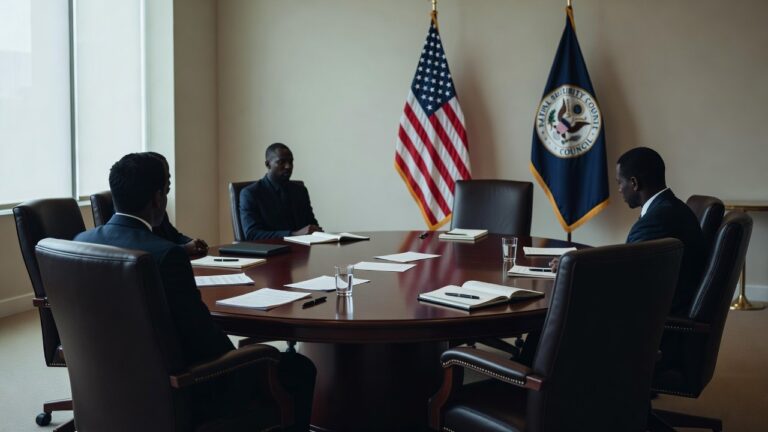
The National Security Council serves as the White House’s central hub for knitting together foreign policy, intelligence, and defense priorities, advising the president while pulling input from across the executive branch and Congress. Created to cut through fragmented advice during the early Cold War, the NSC has long shaped how administrations respond to overseas threats and domestic security questions that voters weigh at the ballot box. When you model this electorally, national security episodes tracked by the NSC frequently register in swing-state polling, though the methodology matters: live-caller surveys of likely voters aged 18-34 often show sharper divides on intervention questions than automated samples weighted toward older cohorts.
The body traces its roots to the National Security Act of 1947, signed by President Truman as the Cold War crystallized. Lawmakers wanted a single venue to merge diplomatic, military, and intelligence streams instead of relying on ad-hoc cabinet counsel. Over the decades the NSC adjusted to new dangers, from nuclear deterrence through terrorism and cyber threats, yet its core remains presidential advice. Historical election patterns reveal the pattern: in 1952, 1968, and 1980, voters rewarded candidates who projected tighter NSC-style coordination on containment or détente, according to exit-poll breakdowns that separated foreign-policy voters in the Midwest and Northeast from those prioritizing domestic issues.
Early Truman and Eisenhower years emphasized containing Soviet reach through regular policy reviews. Meetings grew more routine under later presidents, building a staff that now supports daily deliberations. The polling data here paints a complicated picture—Gallup and Pew tracking from those decades shows Republican-leaning demographics consistently rating NSC-managed alliances higher than Democratic-leaning groups, a split that still appears in contemporary battleground-state crosstabs when foreign-policy questions are asked before economic ones.
After September 2001 the NSC broadened its counterterrorism role, coordinating responses that fed into subsequent campaign platforms. Adjustments between the National Security Advisor and cabinet secretaries have continued, reflecting White House efforts to centralize control amid congressional scrutiny. When you model this electorally, the post-9/11 shift correlated with durable partisan gaps: surveys weighted by education and veteran status show veterans in Sun Belt states giving higher marks to NSC-led interagency efforts than non-veteran suburban cohorts.
Statutory members include the president, vice president, secretary of state, and secretary of defense, with the National Security Advisor running day-to-day coordination. The director of national intelligence and Joint Chiefs chairman add specialized voices. This setup allows broad threat assessment while contending with congressional and public-opinion pressures that intensify during election cycles. Demographic breakdowns in recent ABC/Washington Post polling indicate that Hispanic and Asian-American voters in Arizona and Nevada register more sensitivity to NSC-coordinated Indo-Pacific messaging than White non-college voters in the Rust Belt.
The National Security Advisor serves as the president’s direct conduit, overseeing staff and delivering crisis briefings. Past advisors have steered arms-control talks and Middle East responses, often surfacing in White House messaging that campaigns later test in focus groups. Interagency principals and deputies committees hammer out unified positions on sanctions or deployments, bridging executive action with legislative oversight on funding.
In practice the NSC handles both immediate crises and longer-range planning, reviewing intelligence and weighing military or diplomatic steps that intersect with appropriations debates. Recent coordination on Ukraine packages and Indo-Pacific strategy has appeared in White House briefings that also surface in battleground tracking polls. Presidential transitions test continuity: incoming teams inherit operations yet realign priorities with campaign pledges, a process that historical data shows can shift independent-voter margins in states such as Pennsylvania and Georgia when foreign-policy approval ratings move.
Congress maintains oversight through hearings and reporting mandates, a dynamic that sharpens under divided government. Annual reviews of NSC-related funding sit inside larger intelligence and defense budgets, where partisan negotiation often tracks broader electoral-map calculations about defense-industry employment in key districts.
The NSC’s organizational structure has evolved considerably since its inception. Beyond the statutory members, the organization now includes the White House Chief of Staff, the President’s Press Secretary, and various special advisors depending on administration priorities. During the Cold War, the NSC maintained a smaller, more focused staff concentrated on Soviet affairs. Today’s NSC employs several hundred people across multiple directorates covering regions, functional issues like cyber security and counterterrorism, and cross-cutting concerns such as climate security and economic competitiveness. This expansion reflects the complexity of modern threats and the demand from presidents for coordinated responses that account for diplomatic, military, intelligence, and economic dimensions simultaneously.
The relationship between the National Security Advisor and other cabinet secretaries frequently shapes policy outcomes. While the Advisor lacks statutory authority over State Department or Defense Department operations, the position’s proximity to the president grants substantial influence. Historical examples illustrate this dynamic: Henry Kissinger’s role as National Security Advisor under President Nixon elevated the NSC staff’s profile in arms-control negotiations with the Soviet Union, sometimes creating tension with Secretary of State William Rogers. More recently, NSC staff involvement in diplomatic initiatives regarding North Korea, Iran, and China has reflected changing White House priorities and presidential communication styles.
The NSC’s decision-making process typically flows through two main committee structures: the Principals Committee, where cabinet secretaries and agency heads meet, and the Deputies Committee, composed of second-in-command officials who handle more routine interagency coordination. These committees allow the NSC system to function at multiple levels of government simultaneously—senior leaders addressing presidential priorities while career professionals manage day-to-day implementation. Special interagency task forces may also form around specific crises, from natural disasters to armed conflicts, creating temporary structures tailored to particular challenges.
Intelligence assessment forms the backbone of NSC deliberations. The Director of National Intelligence coordinates input from the CIA, Defense Intelligence Agency, National Security Agency, and other intelligence services, synthesizing classified information for presidential briefings. The NSC’s access to raw intelligence allows its staff to evaluate policy options with current threat assessments, though this classified nature also limits public understanding of how specific decisions were reached. Congressional committees with security clearances receive briefings on major NSC initiatives, creating a channel for legislative oversight without exposing classified methods or sources.
The NSC also plays a crucial role in coordinating economic sanctions regimes, export controls, and technology-transfer restrictions that increasingly intersect with national security. As competition with China and other strategic rivals has intensified, the NSC has worked closely with Treasury, Commerce, and State departments to align policies that restrict advanced semiconductors, artificial intelligence capabilities, and other dual-use technologies. These coordinating functions blur traditional lines between foreign policy and domestic economic policy, requiring NSC staff to understand trade law, international commerce, and technology policy alongside traditional defense and diplomatic concerns.
Crises test the NSC’s ability to coordinate rapidly across agencies with competing institutional interests. During the COVID-19 pandemic, the NSC coordinated with the Department of Health and Human Services, Defense Department logistics networks, and international partners on vaccine distribution and supply-chain security. Similarly, cyberattacks on critical infrastructure trigger NSC-led responses involving the Cybersecurity and Infrastructure Security Agency, FBI, National Security Agency, and relevant sector regulators. These episodes demonstrate how modern national security threats often require civilian, intelligence, military, and technical expertise working in concert rather than sequential decision-making through traditional bureaucratic channels.
Key facts remain consistent since 1947: the NSC was established July 26 under Truman; statutory members are fixed; staff has expanded from a small group to several hundred; every president since has used it for decisions from Korea to cyber defense; the advisor role needs no Senate confirmation yet carries outsize weight; interagency sessions run weekly or more during crises; and congressional budget reviews occur yearly.
Understanding these mechanics highlights how the NSC threads executive expertise with electoral realities, guiding responses to global challenges while adapting to congressional and voter pressures that shift with each cycle.