
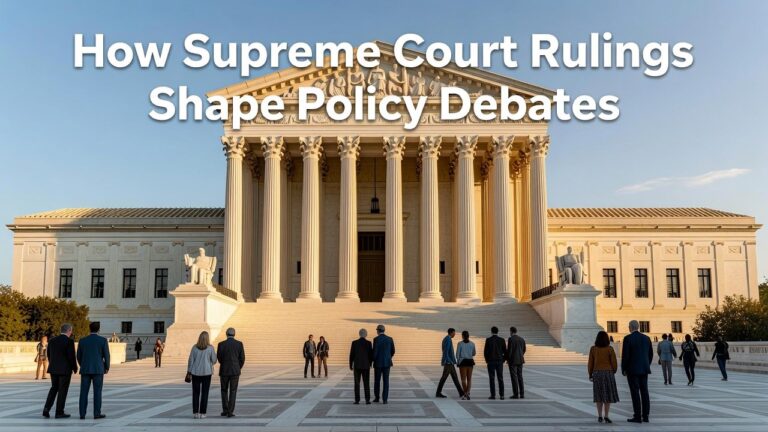
Supreme Court decisions continue to recalibrate the battlefield for American elections, pushing both parties to adjust messaging and legislative tactics in ways that show up clearly in polling cross-tabs and historical turnout models. From Marbury v. Madison onward, the Court has set boundaries that Congress and state legislatures must work around, and those boundaries frequently become the backdrop for midterm and presidential campaigns where voter coalitions shift along demographic lines.
Landmark precedents such as Brown v. Board of Education illustrate the pattern. The 1954 ruling forced federal enforcement of desegregation and kept education equity on the agenda through subsequent decades, with polling from the era and later showing consistent partisan divides by region and race that still echo in contemporary surveys of Southern and suburban voters. New Deal-era shifts on commerce power similarly redirected policy, often surfacing as campaign flashpoints when candidates position themselves relative to judicial philosophy rather than specific statutes.
Recent terms have accelerated this dynamic. The 2022 Dobbs decision returned abortion regulation to the states, producing near-total bans in 14 states and elevating the issue in the 2022 midterms. Post-election polling, including exit surveys and academic turnout analyses, recorded a 3-5 percent average increase in participation in affected states, with notable lifts among women under 45 and college-educated suburbanites—demographics that have trended Democratic in recent cycles. At the same time, Republican-leaning rural and working-class cohorts showed steady or slightly higher engagement when state-level ballot measures framed the issue around parental rights or limits. The polling data here paints a complicated picture, as national generic-ballot averages moved only modestly while state-level surveys revealed sharper swings in places like Michigan and Pennsylvania.
The interplay between Court decisions and electoral strategy reveals how quickly campaigns mobilize around judicial outcomes. When the Dobbs decision was announced in June 2022, Democratic operatives immediately began polling language on reproductive freedom, while Republican strategists tested messaging around state sovereignty and legislative process. Within weeks, ballot initiatives in Kansas, Michigan, and other states became central organizing tools for both parties, with grassroots activation following the Court’s opinion rather than preceding it. This reactive pattern—where campaigns scramble to frame judicial rulings in ways that energize their base—has become standard in post-2010 American politics.
The 2024 Loper Light ruling ending Chevron deference has similarly narrowed agency latitude on environmental, labor, and healthcare rules. When you model this electorally, the effects register most in industrial and energy-producing states where regulatory rollback arguments test well among non-college voters but face resistance in coastal and tech-heavy districts. Congressional responses now emphasize narrower statutory language, a shift already visible in 118th Congress hearing volume—more than 50 sessions tied to post-Dobbs legislation alone. This shift toward more explicit statutory language rather than delegating rulemaking authority to agencies represents a fundamental change in how Congress drafts legislation. Environmental advocates worry that removing Chevron deference will make it harder to update regulations as science evolves, while business groups celebrate reduced regulatory uncertainty. The political ramifications extend beyond Congress to state legislatures, where similar debates about agency authority now dominate committee work on labor and environmental matters.
Voting-rights cases such as Shelby County and Brnovich have likewise prompted state-level adjustments, with Democrats highlighting access metrics in urban precincts and Republicans stressing verification protocols in rural ones. Historical patterns from the post-2013 period show turnout differentials by race and age narrowing or widening depending on state rules, a trend reflected in 2022 validated-voter-file studies. The Shelby County decision in 2013, which struck down the preclearance requirement of the Voting Rights Act, fundamentally altered the landscape for voting rights litigation and policy. States previously required to clear voting changes with the Department of Justice have since implemented stricter voter ID requirements, reduced early voting periods, and purged voter rolls more aggressively. These changes have become centerpieces in Democratic campaign messaging about voting access, while Republicans frame them as election security measures. The polling divergence on these issues tracks almost perfectly along partisan lines, with Democrats emphasizing voter suppression and Republicans emphasizing election integrity—two frames derived directly from how the Court’s opinions were written and contested.
The mechanisms through which Court rulings influence policy extend beyond electoral messaging. Legislative staffers and policy analysts in both parties now routinely consult Supreme Court opinions when drafting bills, seeking to craft language that will survive constitutional scrutiny. This defensive legislative drafting has become more prevalent as the Court has shown greater willingness to strike down federal statutes. The American Legislative Exchange Council (ALEC), a conservative group that drafts model legislation for state legislatures, explicitly incorporates judicial philosophy into its templates. Similarly, progressive organizations like the Center for American Progress analyze Court opinions to identify legislative openings where new statutes might achieve progressive policy goals within current constitutional boundaries. This arms-race dynamic between courts, legislatures, and interest groups has intensified substantially over the past 15 years.
Gun-control and affirmative-action rulings have followed parallel tracks, feeding into campaign ads that test differently across age cohorts and educational attainment levels in battleground maps. The Supreme Court’s 2022 ruling in New York State Rifle & Pistol Association v. Bruen struck down New York’s licensing regime and cast doubt on numerous gun regulations nationwide. Within months, Democratic candidates began running ads about the ruling in districts with college-educated swing voters concerned about gun violence, while Republican candidates highlighted it as a win for Second Amendment rights in rural areas. The affirmative-action ruling in Students for Fair Admissions v. Harvard similarly animated both bases, with conservatives celebrating the end of race-conscious admissions and progressives warning about resegregation of higher education. These cultural and constitutional issues often mobilize voters more effectively than traditional economic messaging, which explains why candidates now devote substantial campaign resources to explaining or defending Court decisions.
Public approval for the Court has hovered between 40 and 60 percent since 2020, with methodology notes from multiple trackers indicating sharper partisan gaps than in prior decades—roughly 30-point spreads between self-identified Democrats and Republicans in most national samples. These fluctuations track media intensity around major opinions and feed directly into candidate positioning on judicial appointments, a topic that historically boosts base mobilization more than persuadable independents. The Court’s legitimacy as an institution has become explicitly partisan in ways that would have seemed unlikely a generation ago. Calls from progressive activists for Court-packing or term limits gain traction when the Court rules against Democratic priorities, while conservatives defend the institution’s independence. This zero-sum framing around the Court’s composition and legitimacy suggests that future judicial appointments will remain central to electoral competition regardless of specific policy outcomes.
Across more than 25,000 opinions since 1789 and the typical 60-70 cases per term that touch federal implementation, the through-line remains consistent: rulings redefine the terrain on which electoral coalitions form and policy agendas compete. Both parties continue to adapt strategies around those new lines, with demographic and regional polling providing the clearest early signals of where pressure will next intensify. Understanding this relationship between judicial decisions and electoral politics is essential for anyone tracking contemporary American political development, because the Court’s role in setting policy boundaries has only grown more prominent as partisan polarization has increased legislative gridlock.