
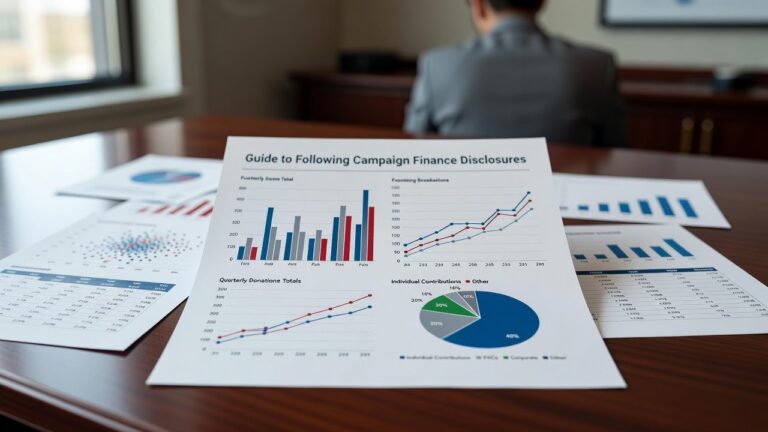
As a Latina journalist covering Washington accountability, I’ve learned that campaign finance disclosures aren’t just paperwork—they’re the raw ledger of who’s buying influence in Congress and the White House. Following these public records gives voters, journalists, and analysts a clear window into the money shaping elections, from individual donor checks to the explosion of outside spending that now dwarfs traditional party operations.
The financial disclosures tell a story the press releases don’t. Mandatory filings with the Federal Election Commission detail contributions above set thresholds, itemized expenditures, and debt obligations from candidates, political action committees, parties, and independent groups. These reports create an official timeline of financial activity that often explains why certain industries push hard on tax reform or healthcare legislation.
Primary Sources for Tracking the Money
The FEC’s own database remains the official starting point. Searchable records include Form 3 filings for House and Senate candidates, bulk data downloads, and real-time updates during campaign season that show fresh contributions from individuals, corporations, and unions. Cross-referencing these with lobbying disclosure reports adds another layer, revealing which registered lobbyists are bundling donations or steering clients toward favored candidates.
Platforms like OpenSecrets and FollowTheMoney.org turn raw FEC numbers into usable maps of super PAC spending and the dark money flowing through 501(c)(4) groups that often shield donor identities. These tools expose how outside groups target specific districts or presidential battlegrounds, sometimes coordinating through shared consultants and vendors.
The FEC website itself offers several search functions that cater to different research needs. The “Contributions by Individuals” search lets you identify who’s donating to which campaigns—useful for tracking patterns among wealthy donors or industry executives. The “Disbursements” search shows where candidate money actually goes, from payroll to media buys to polling. During election years, the FEC updates its data multiple times per week, so checking back regularly can reveal shifting spending priorities as campaigns respond to polling or emerging races.
Reading Between the Lines on the Forms
Schedule A filings list individual contributions, while Schedule B tracks operating expenditures. Patterns worth watching include repeated large transfers between party committees and bundled donations funneled through lobbyists. Super PACs must report independent expenditures within 24 or 48 hours, giving analysts quick notice of which outside players are flooding airwaves in key races.
Understanding the distinction between different committee types is crucial for comprehensive analysis. Traditional PACs, also called “connected PACs,” are affiliated with corporations, unions, or trade associations and face contribution limits of $5,000 per donor per election. Super PACs, created after the 2010 Citizens United Supreme Court decision, can accept unlimited contributions but must report independent expenditures that cannot be coordinated with candidates. Leadership PACs, established by individual politicians, allow them to raise and distribute funds to allied candidates while building personal political power. Each committee type follows slightly different reporting rules, so knowing which form you’re examining matters greatly.
The timing of donations also tells a story. Heavy giving in the months before an election suggests donors are hedging bets or signaling support for races they expect to be competitive. Mid-cycle giving spikes sometimes indicate emerging threats to incumbents or strategic shifts in party priorities. Tracking when major donors cut checks—and to whom—can reveal internal disagreements within industries or coalitions about which candidates deserve support.
Connecting Donations to Policy Outcomes
One of the most revealing exercises is correlating donation patterns with voting records or legislative priorities. When you notice a senator receiving substantial contributions from pharmaceutical executives, then voting against drug price negotiation measures, that alignment becomes visible in the public record. Environmental groups bundling donations often precede floor votes on climate legislation. Tracking these connections requires patience but yields clarity about the relationship between financial support and legislative behavior.
Industry bundlers deserve special attention. A single lawyer or consultant who collects donations from multiple clients and delivers them to a campaign has outsized influence. The FEC requires bundlers to disclose their activities when they aggregate $15,000 or more in a calendar year, and these reports reveal networks of influence that wouldn’t be apparent from individual donation searches alone.
The numbers from recent cycles make the stakes obvious. Outside spending topped $2.6 billion in the 2020 election cycle according to FEC records. Super PACs drove more than 60 percent of independent expenditures in recent House races. Dark money groups poured over $1 billion between 2010 and 2022 without full donor disclosure. The average Senate candidate filed more than 200 disclosure reports across a typical six-year term. Individual donors hitting the legal maximum rose 45 percent from 2016 to 2020. Presidential campaigns now monitor daily FEC updates to track opponents in real time.
Strategic Uses for Campaign Finance Data
Journalists use these filings to fact-check candidates’ claims about grassroots support. If a candidate claims to be funded by small donors but the data shows 60 percent of their money comes from bundlers and wealthy contributors, that’s newsworthy. Researchers studying influence track whether candidates who receive donations from specific industries later support those industries’ preferred policies. Election observers monitor whether incumbents face well-funded challengers, a key indicator of competitive races. Advocacy organizations use the data to hold elected officials accountable to their supporters.
At the state and local level, campaign finance disclosures follow different rules than federal elections but serve identical transparency purposes. Some states require more frequent filing, lower contribution limits, or stricter donor identification rules. Secretary of state offices maintain searchable databases for gubernatorial, state legislative, and ballot measure campaigns. These records are often less scrutinized than federal filings but can reveal significant local influence networks.
Tools and Strategies for Deeper Dives
Beyond the FEC database, several complementary resources enrich campaign finance research. The Center for Responsive Politics publishes detailed analysis of industry giving patterns and tracks “revolving door” employment between Congress and lobbying firms. Ballotpedia maintains comprehensive candidate finance data focused on state races. ProPublica’s data store includes downloadable campaign finance datasets going back years. For international comparisons, the International Institute for Democracy and Electoral Assistance publishes campaign finance regulations and spending data from democracies worldwide.
Building a research workflow saves time and ensures consistency. Start with a candidate name in the FEC database to see their total receipts and major donors. Cross-reference those donors in the lobbying disclosure database to understand their interests. Check if any are bundlers using the bundler search. Review the candidate’s legislative record or policy positions on issues relevant to those donor industries. Look for patterns: Do donations spike before key votes? Do certain sectors dominate their funding? Does their voting align with donor interests?
Limitations and What Data Cannot Show
Campaign finance disclosures have real gaps worth acknowledging. Dark money groups don’t report donors, making the true sources of billions in spending invisible. Disclosure thresholds mean small donations below $200 aren’t itemized. In-kind contributions sometimes undervalue the true cost of services provided. Coordination between campaigns and outside groups can be subtle and difficult to prove from financial records alone. Post-election consulting payments and “travel expenses” sometimes disguise personal enrichment that FEC rules technically permit.
The FEC itself operates with two permanent vacancies and often deadlocks along partisan lines when voting on enforcement matters, limiting the agency’s ability to police violations. This means relying on these records requires understanding that they’re self-reported to some degree, though serious violations do carry legal penalties.
Mastering these filings lets citizens track the financial forces behind legislative priorities and hold officials accountable when public positions appear to track private funding. Regular review of FEC records and independent analysis tools remains the most direct path to understanding who really sets the agenda in Washington. Whether you’re a voter deciding who to support, a journalist investigating influence, or an engaged citizen simply paying attention, the data is there—free, public, and waiting to tell you where the money flows.