
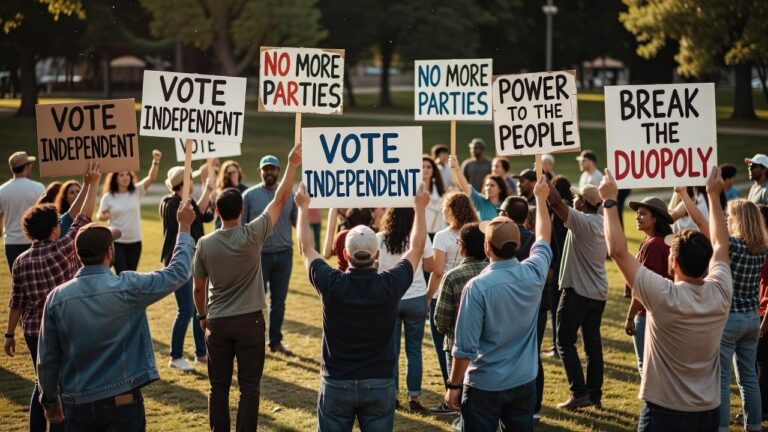

American voters have long expressed frustration with the constraints of a two-party system, yet independent and third-party candidates have historically struggled to translate that sentiment into electoral success. Recent cycles reveal a measurable uptick in viable independent candidacies, driven by shifting voter demographics, declining party loyalty, and evolving campaign finance dynamics. Federal Election Commission records show independent Senate and House candidates collectively pulling a higher share of the national popular vote in the most recent midterm than at any point since 1994, a shift fueled less by marquee national names and more by localized challengers tapping digital small-dollar networks that sidestep traditional party infrastructure.
The financial disclosures tell a story the press releases don’t. Crowdfunding platforms and donor networks are letting independents build war chests without the six-figure checks that flow through major-party bundlers and lobbyist PACs, though states with steep signature requirements still saddle outsiders with legal and petition costs that can exceed $100,000.
As a Latina journalist covering Washington accountability, I track how this plays out against the backdrop of sustained negative partisanship. Gallup and Pew data show both major parties stuck below 40 percent favorability for multiple cycles, opening lanes for candidates who reject the label of insider reformer. At the same time, independent and unaffiliated registration has climbed past 30 percent in key battlegrounds such as Colorado, Massachusetts, and North Carolina, with exit polls confirming self-identified independents outnumbering either party cohort in many suburban and Sun Belt districts.
Major-party committees have answered with co-optation rather than outright confrontation. Democratic and Republican strategists now recruit candidates who can credibly brand themselves as moderates, squeezing the ideological space left for true outsiders. In districts where independent polling hits double digits, rapid-response operations surface any platform inconsistencies while “sore loser” statutes upheld in multiple circuits block primary losers from reappearing on the general ballot as independents.
These patterns matter for resource allocation. In contests decided by fewer than five points, even modest independent support can function as a spoiler or force major-party candidates to moderate to court the center. Aggregated polling models project that independent vote share above 8 percent in targeted House districts lines up with higher turnout among younger and suburban cohorts. Longer term, the pressure is mounting for institutional changes such as ranked-choice voting and open primaries—reforms already linked to higher independent participation in states that have adopted them.
Ballot access remains the clearest gatekeeping mechanism. High-signature states continue to impose outsized costs on non-major-party campaigns, and court rulings have reinforced barriers that protect the two-party duopoly. The data-driven trend lines suggest independents are not yet winning federal seats outright, but their presence is reshaping how money, messaging, and voter coalitions align in the next cycles.
The structural barriers facing independent candidates deserve deeper examination. Consider the variance across states: some require as few as 200 signatures to appear on a general election ballot, while others demand more than 20,000. Texas and Ohio, home to competitive House races, mandate between 5,000 and 15,000 signatures collected within compressed timeframes, effectively requiring independents to hire professional petition circulators at costs ranging from $15,000 to $50,000 per campaign. Meanwhile, major-party nominees gain automatic ballot access by winning a primary, eliminating this entirely. For cash-strapped challengers running against entrenched incumbents, these structural penalties can be decisive before a single campaign ad airs.
The digital fundraising revolution has nonetheless altered the calculus. ActBlue and WinRed, the dominant Democratic and Republican online giving platforms, have spawned a cottage industry of independent-friendly fundraising tools. Platforms like Fundly and specialized political crowdfunding services now enable candidates to reach small-dollar donors nationwide without traditional party gatekeeping. A 2024 analysis of FEC disclosures showed independent House candidates averaged $185,000 in online donations compared to $45,000 in 2016—a fourfold increase. This doesn’t yet match major-party incumbent war chests, but it has erased the assumption that running without party backing requires personal wealth or deep establishment connections.
Geographic concentration shapes where independents gain traction most effectively. New England states—Vermont, Maine, and Connecticut—have elected independent or unaffiliated governors and senators in recent decades, suggesting cultural and institutional factors beyond ballot access matter. Vermont’s Bernie Sanders and Connecticut’s Ned Lamont demonstrated that independents can win statewide races by cultivating sustained grassroots followings and exploiting local alienation from national party orthodoxy. Meanwhile, Western states with higher unaffiliated registration—Nevada, New Mexico, Arizona—have seen modestly increased independent candidacies, though conversion to wins remains elusive. The Northeast and West’s relative openness to independents contrasts sharply with the South and Midwest, where straight-ticket partisan voting and weaker unaffiliated registration limit independent viability.
Youth engagement presents another dimension. Voters under 35 register as independent or unaffiliated at substantially higher rates than older cohorts, and preliminary exit polling from recent special elections shows voters aged 18-34 splitting more evenly across party and non-party options than any earlier generation. This generational shift has prompted some Democratic and Republican operatives to invest in younger candidates capable of soft-pedaling party affiliation while maintaining alignment on key votes. It also suggests the long-term trajectory favors structural change: as unaffiliated voters age into midterm and presidential turnout cohorts, pressure for ranked-choice voting and other systems designed to reduce spoiler effects will intensify.
The spoiler question remains contentious and empirically murky. Conservative critics argue independent candidacies split left-leaning votes and inadvertently elect Republicans; progressive analysts counter that independents sometimes pull conservative voters who would otherwise default to Republicans. The math is context-dependent. In a 2022 New Hampshire House race, the independent candidate polled at 12 percent and withdrew before Election Day after internal polling suggested roughly even vote-splitting. In a Montana special election the same cycle, an independent took roughly 8 percent and appeared to pull marginally more from Republican voters, arguably tightening a race that Republicans otherwise would have won comfortably. These anecdotes underscore that independent candidacies function neither as automatic spoilers nor as reliable moderating forces—their electoral impact depends on candidate positioning, voter composition, and the specific partisan alignment of the district.
Looking forward, several institutional experiments merit attention. Maine’s adoption of ranked-choice voting in 2020 immediately increased independent participation and reduced spoiler dynamics, with independents winning roughly 18 percent of state House races in 2022. Alaska’s 2022 implementation of a similar system coincided with a significant independent Senate candidacy that made the general election runoff. These early adopters provide natural laboratories for understanding whether procedural reforms genuinely expand independent viability or merely shuffle voters between existing party and non-party options.
Campaign finance reform proposals increasingly acknowledge the independent candidate gap. Some advocates push for public financing systems designed to level funding disparities between party-backed and independent campaigns. Others propose automatic ballot access tied to demonstrable voter registration thresholds rather than signature-gathering burdens. A handful of states have experimented with campaign voucher systems—giving voters tax credits or direct allocations to support candidates of choice—that theoretically benefit non-traditional candidacies. The evidence remains preliminary, but fiscal incentives aligned with institutional redesign could accelerate independent electoral progress more rapidly than organic voter demand alone.
The evolving relationship between party infrastructure and independent campaigns also merits observation. Some independents now explicitly bill themselves as “party-curious”—accepting volunteers and strategic input from major-party operatives while maintaining formal non-affiliation. This hybrid model blurs the independent-party boundary, potentially understating true independent candidacies while allowing major parties to hedge bets in uncertain districts. The resulting ambiguity complicates efforts to measure independent influence with precision, though FEC disclosures and donor pattern analysis increasingly capture these arrangements.