

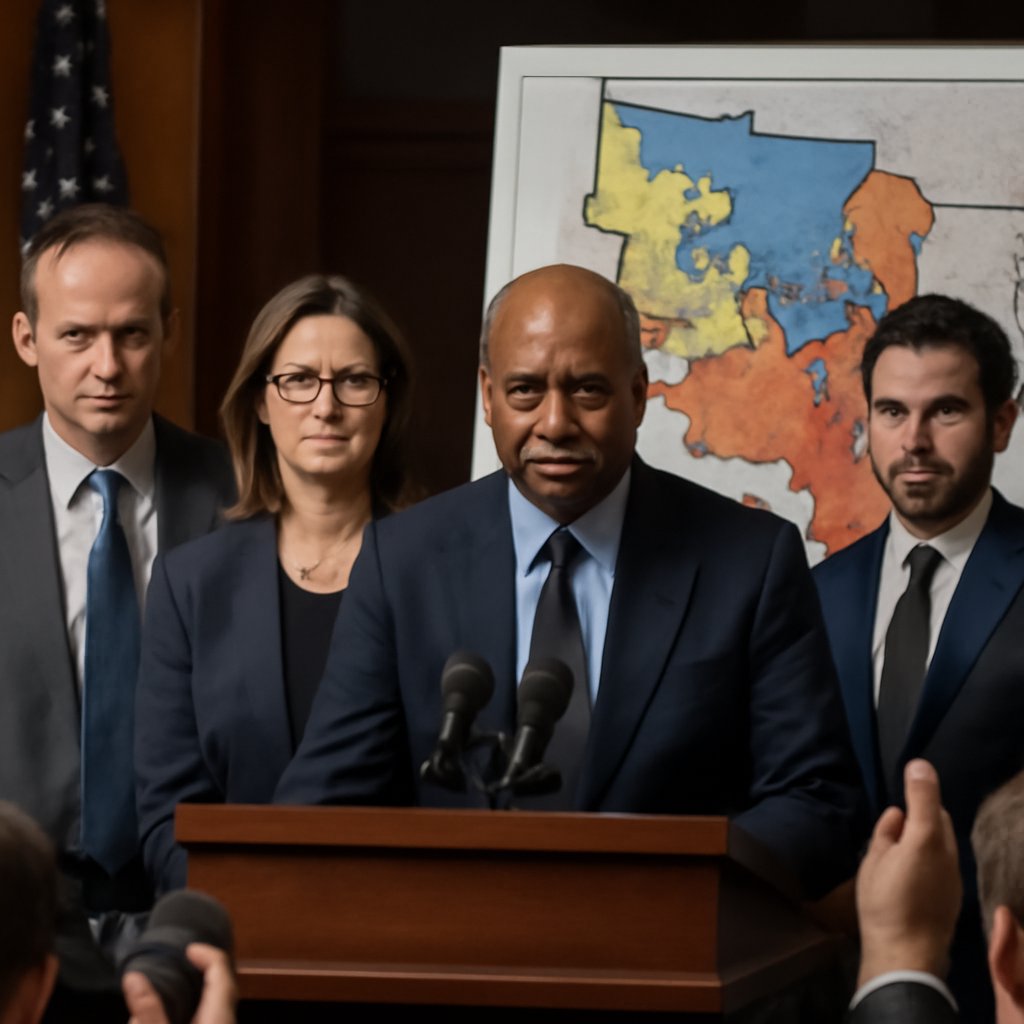
As a Latina journalist who’s tracked campaign finance filings from state capitals to Capitol Hill for more than a decade, the redistricting process stands out as one of those moments when lobbying money and partisan map-drawing quietly lock in advantages long before any ballot is printed. Every ten years, states redraw congressional districts using fresh census data to balance population. In most states the legislature controls the pen, though a few jurisdictions hand the job to independent commissions. Federal courts have drawn sharper lines around racial gerrymandering than around pure partisan line-drawing, leaving state constitutions and statutes to fill the gaps with rules on compactness, contiguity, and respect for county lines.
The financial disclosures tell a story the press releases don’t: in unified-party states, contributions from real-estate PACs, energy interests, and tech trade groups spike in the months before map votes, often flowing to the same lawmakers who later chair redistricting committees. Those records don’t prove causation, but they document the access that precedes the lines.
Mapmakers rely on two classic moves. Cracking spreads one party’s voters across many districts so none reaches a majority, while packing concentrates them into a handful of districts they win by lopsided margins, wasting their surplus votes. Modern software lets staff run thousands of simulations against turnout models, sharpening the precision. Strategic placement of majority-minority districts and oddly shaped boundaries that scoop up or exclude specific precincts add further levers. Lobbying disclosures from groups that hire the consultants running those simulations show six-figure retainers paid in the run-up to final votes, money that rarely appears in the official redistricting hearing transcripts.
Researchers measure the damage with tools such as the efficiency gap, which tallies wasted votes—ballots for losers plus surplus votes in winners’ districts. A large gap signals one party converting votes into seats more efficiently. Mean-median differences, declination scores, and ensemble analyses that compare enacted maps against thousands of randomly drawn alternatives all point in the same direction: states under single-party control routinely deliver three-to-five-point seat bonuses relative to statewide vote shares. Campaign-finance data add another layer; candidates in the resulting safe seats raise larger sums from fewer donors, reducing the pressure to court swing voters.
The downstream effects show up in competitiveness scores and constituent-service gaps. Districts drawn by one party tend to produce fewer marginal races, shifting real contests to low-turnout primaries. Elongated shapes and split counties complicate outreach to communities of interest, a pattern visible in quantitative audits of compactness that compare commission-drawn maps with those produced under unified control.
The legal landscape surrounding gerrymandering has shifted considerably over the past two decades. The 2019 Supreme Court decision in Rucho v. Common Cause marked a watershed moment, ruling that federal courts lack the power to police partisan gerrymandering under the Constitution, leaving the issue to state legislatures and courts. This decision effectively closed the federal courthouse door to many partisan gerrymandering challenges, though it did not restrict claims based on racial discrimination or violations of the Voting Rights Act. Since then, several states have strengthened their own constitutional protections or passed laws requiring independent redistricting commissions. California, Michigan, and Arizona have moved toward commission-based processes, while others rely on court oversight or legislative supermajorities to create higher bars for map adoption. Understanding which mechanism your state uses is crucial for citizens wanting to influence the process.
The 2020 Census presented particular challenges for redistricting because of an unprecedented delay in data release and disputes over the apportionment of House seats among states. Some states did not finalize their maps until well into 2022, creating legal uncertainty and compressed timelines for candidate recruitment. The combination of pandemic delays, litigation, and political tensions made the 2021–2022 redistricting cycle notably contentious. Court intervention was required in multiple states to settle map disputes after legislatures deadlocked or governors vetoed plans. States like New York saw maps drawn by courts after lawmakers could not agree, while Ohio’s maps were repeatedly struck down and redrawn by the state’s Redistricting Commission. These real-world clashes illustrate how the formal rules and informal power dynamics interact.
Technology has transformed mapmaking in ways that deepen both the opportunity and the opacity of partisan advantage. Vendors like Dave’s Redistricting, Maptitude, and proprietary platforms used by state capitals allow operators to manipulate district lines in real time while watching demographic and partisan data shift. The ability to run thousands of simulations and select the map that maximizes one party’s advantage while maintaining a veneer of legality—compactness language in bills, claims of respecting communities of interest—has made gerrymandering more surgical and harder to prove in court. Some legislatures now release granular detail on how maps were drawn, including software logs and meeting minutes, but others withhold this information or claim it’s proprietary. Transparency advocates have pushed for public software and open-source mapping tools, arguing that sunlight is the best disinfectant. A handful of states now require draft maps to be posted online for public comment before final votes, creating a window for citizen scrutiny that did not exist in prior cycles.
Minority voting rights remain a central concern in redistricting even as partisan gerrymandering escapes federal oversight. The Voting Rights Act requires states with a history of discrimination to ensure that minority communities are not packed into too few districts or diluted across so many that their voting power is suppressed. The tension between these protections and partisan mapmaking can create perverse outcomes: a state might pack Black and Latino voters into majority-minority districts to comply with federal law while simultaneously cracking white Democratic voters into surrounding districts to maximize Republican advantage. Civil rights organizations have become more active in redistricting litigation, arguing that partisan gerrymandering in practice disproportionately harms voters of color. Federal courts have blocked some maps on racial grounds, though the bar is high and the Shelby County decision in 2013 stripped the preclearance requirement from the Voting Rights Act, reducing federal oversight in states with histories of discrimination.
The role of individual states’ constitutions in shaping redistricting has grown more significant. States like Pennsylvania, North Carolina, and Wisconsin have all seen state-court challenges to maps under state constitutional protections for equal voting rights or democratic process, even after federal courts declined to act. Some state constitutions explicitly mandate that districts be compact and contiguous, or that communities of interest be respected. Advocates increasingly focus their energy on state-level litigation and ballot initiatives rather than waiting for federal courts to step in. This devolution to the states means that the rules governing redistricting now vary dramatically from place to place, creating a patchwork landscape where the legitimacy of your congressional district depends partly on which state you live in.
Reform efforts continue through independent commissions, ranked-choice voting experiments, and tighter statutory criteria. Transparency rules now require some states to release draft maps and software logs, giving watchdogs earlier looks at proposed lines. Longitudinal datasets tracking efficiency gaps and competitiveness offer benchmarks for spotting when a new plan departs from historical norms. As lobbying reports and campaign-finance filings accumulate around each cycle, they supply an additional ledger—one that records whose interests are protected when the lines are finally drawn. Citizen engagement during the public comment periods for redistricting has also grown, with organizations training volunteers to testify at hearings and submit written comments that become part of the official record. These interventions may not always change outcomes, but they create documentation that can be used in future litigation or advocacy.
Looking ahead to 2031 and the next redistricting cycle, questions loom about how artificial intelligence and machine learning will reshape the mapping process. Some reformers hope these tools can be harnessed to generate more fair maps based on objective criteria, while critics worry they could make partisan manipulation even more invisible and efficient. The interplay between technology, law, politics, and campaign finance will define whether redistricting becomes more or less democratic in the decade to come.