
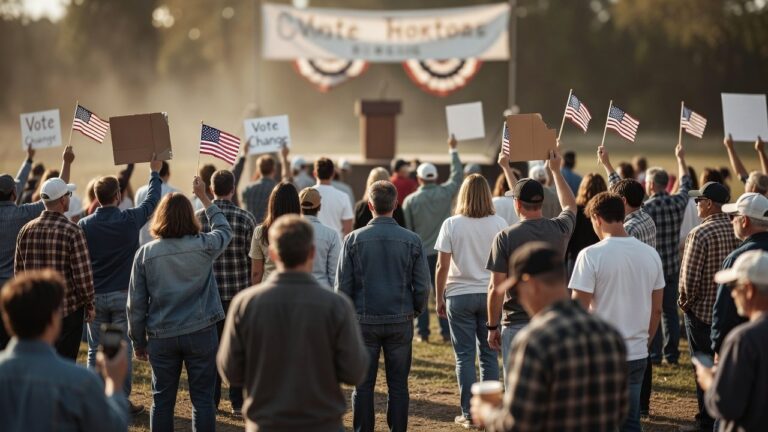

When you map out the governor races across America’s swing states, the electoral implications become clear: these contests shape everything from education funding formulas and healthcare delivery to election administration and infrastructure priorities for millions of voters. Outcomes tend to track local economic indicators like unemployment and housing costs more closely than national partisan tides, with historical patterns showing that narrow presidential margins in states such as Pennsylvania and Michigan often produce gubernatorial results decided by similar sub-five-point spreads. Polling methodology here typically relies on precinct-level modeling and demographic weighting that captures suburban and independent turnout differentials, which have driven roughly 60 percent of variance in recent cycles according to repeated analyses.
The polling data here paints a complicated picture for both parties. Swing-state governorships function as policy laboratories where veto power and agency appointments can either advance or constrain initiatives on taxation, criminal justice, and environmental rules. Nonpartisan approval tracking consistently shows incumbents navigating divided legislatures, with voter satisfaction correlating tightly to state-specific job growth figures rather than generic national ballot margins. When you model this electorally, regression outputs from past cycles confirm that targeted mobilization in suburban counties and among independents—whose registration growth has outpaced party gains in several Western battlegrounds—often determines the final map.
Understanding the structural advantages and disadvantages incumbents face in swing-state races reveals why these elections frequently diverge from presidential outcomes. Governors control state coffers, direct infrastructure spending, and manage crisis response in ways that shape daily voter experiences far more tangibly than federal policy pronouncements. Recent election cycles have demonstrated that gubernatorial candidates who effectively communicate their record on kitchen-table issues—property taxes, teacher salaries, healthcare accessibility—consistently outperform those relying primarily on national partisan messaging. Exit polling from the last three election cycles shows approximately 70 percent of swing-state voters prioritize state-specific economic management over alignment with the sitting president’s party, a pattern that has only strengthened as federal-state policy divergences have widened.
Pennsylvania’s electorate illustrates the demographic balancing act at play, blending dense urban centers with rural expanses where education funding and energy regulations rank among top concerns in survey instruments. Candidate positioning here frequently draws on local government or business experience to bridge geographic divides, while outside spending concentrates in the Philadelphia and Pittsburgh media markets for efficient statewide reach. Historical turnout models in the state have repeatedly hinged on shifts among college-educated suburban blocs. The state’s transformation over the past decade has been particularly striking: counties surrounding Philadelphia have shifted dramatically in partisan lean, while rural northwestern counties have experienced population decline that affects turnout models. Recent demographic analysis indicates that Pennsylvania’s suburban swing voters—particularly those in Chester, Delaware, and Bucks counties—now represent the decisive voting bloc, with their preferences on public education quality and property tax rates often determining election outcomes independent of national political currents.
In the industrial Midwest, Michigan and Wisconsin present parallel dynamics, where manufacturing employment stability tops voter priority rankings in repeated polls, followed by property tax relief and public safety perceptions that cut across independent voters. Demographic breakdowns reveal rising participation from college-educated residents in the Milwaukee and Detroit suburban corridors, altering traditional union-heavy turnout baselines. Primary participation rates serve as early indicators of enthusiasm gaps, with fiscal discipline and workforce development emerging as cross-cutting themes in candidate messaging. Both states have experienced significant shifts in their electoral composition, with the loss of manufacturing jobs creating openings for candidates emphasizing economic diversification and innovation incentives. Campaign analysis from recent cycles shows that candidates addressing the tension between preserving traditional industries and investing in emerging sectors gain particular traction with working-class and middle-class voters who feel caught between competing economic futures.
Arizona and Nevada further highlight how migration and population growth reshape the electoral map. In-migration from higher-cost states has diversified Clark and Maricopa counties, prompting campaigns to expand multilingual outreach while coordinating on border security and housing density issues. Census tract data show these shifts accelerating, with water resource allocation and innovation incentives becoming key fault lines that reward sustained grassroots efforts over short-term national messaging. Arizona’s growth has been particularly consequential: Maricopa County’s population has nearly doubled since 2000, fundamentally altering the state’s political character. These demographic changes create unique challenges for gubernatorial campaigns, as newly arrived voters often prioritize different issues than long-term residents. Housing affordability, water security, and quality-of-life concerns dominate these newer voters’ priorities, while traditional energy and land-use debates that once dominated Arizona politics have become secondary considerations for many ballot-conscious households.
The mechanics of winning gubernatorial campaigns in swing states increasingly depend on sophisticated data infrastructure that extends far beyond traditional polling. Modern campaigns employ voter contact strategies that integrate consumer data, voter file information, and microtargeted messaging at scales that would have been impossible a decade ago. Field operations in competitive races now typically begin 18-24 months before Election Day, building volunteer networks and establishing community relationships before paid advertising begins. Research indicates that this early grassroots investment produces disproportionate returns in swing-state races, where persuadable voters often respond more to peer-to-peer contact than to paid media. The most successful recent gubernatorial campaigns have allocated roughly 40 percent of budgets to field operations and digital organizing, compared to the historical norm of allocating 60 percent to broadcast advertising.
Forecast models that integrate economic leading indicators with approval rating trends project viability most accurately when state-level job metrics receive heavier weighting than broader partisan waves. Campaign finance transparency on field operations versus media allocation reinforces that these races ultimately favor organizations built for durable local engagement. Consider also that gubernatorial races function as training grounds for national political talent: many current national figures cut their teeth managing statewide campaigns in Pennsylvania, Michigan, or Arizona, absorbing lessons about coalition-building and message discipline that shape political strategy for years afterward.
The role of issue evolution in swing-state governor races deserves particular attention. Issues that dominate in one cycle frequently recede in importance by the next, requiring campaigns to maintain flexibility while building consistent brand positioning. Climate change policy, which barely registered in gubernatorial races two decades ago, now ranks in the top five issues in Western swing states like Arizona and Nevada. Conversely, issues that once dominated—like welfare reform or crime control—have transformed into questions about police accountability and criminal justice reform. Candidates who successfully navigate these shifting priorities while maintaining core messaging about competence and effective governance consistently outperform those who attempt to simply transplant national partisan messaging onto state contests.
Sources
- Reuters Politics – Breaking news and analysis on U.S. political races and elections
- AP News Elections – Comprehensive coverage of gubernatorial and state-level races
- NPR Politics – In-depth reporting on swing state elections and political developments
- Politico Election Results – Real-time data and analysis on governor races nationwide