
n
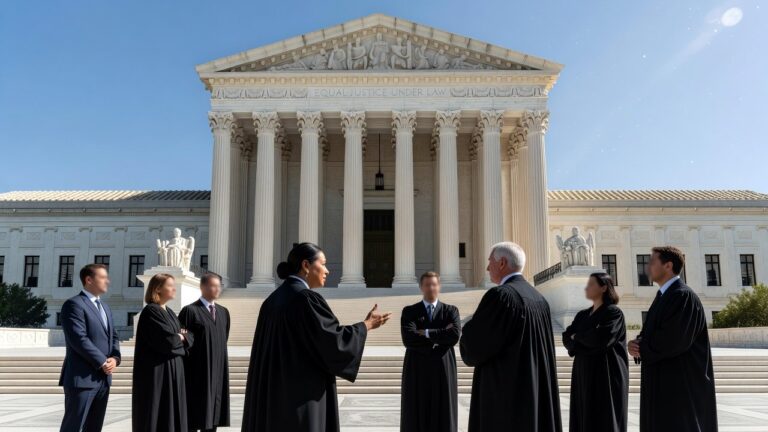
Justice Sonia Sotomayor has offered direct commentary on how she approaches her conservative colleagues on the Supreme Court. Her sotomayor views on conservative colleagues surface regularly in oral arguments, written opinions, and public remarks that focus on institutional norms rather than personal attacks. These observations help map the current fault lines inside the Court’s nine-member chamber.
n

n
Early Signals from the Bench
n
Sotomayor joined the Court in 2009 after a career as a prosecutor and federal trial judge. From the start she signaled willingness to press colleagues whose reasoning she found incomplete. In early cases involving criminal procedure and voting rights she asked pointed questions that highlighted differences with Justices Antonin Scalia and Clarence Thomas.
n
Approach to Chief Justice John Roberts
n
Relations with Roberts remain professional and often collaborative on procedural matters. Sotomayor has joined Roberts in narrow majorities that avoid sweeping constitutional rulings. At the same time she has written separate opinions when she believes Roberts’ incremental path leaves important questions unresolved. Court transcripts show her citing Roberts’ own prior statements to urge consistency across terms.
n
Perspectives on Justices Thomas and Alito
n
Thomas and Alito represent the Court’s most consistent originalist and textualist voices. Sotomayor has criticized opinions from both when she believes historical analysis overlooks later constitutional developments. In a 2022 voting-rights dissent she referenced Thomas’s methodology and argued it produced results at odds with congressional intent. She has also questioned Alito’s framing of free-speech precedents in cases involving public employees and campaign finance.
n
- n
- Thomas opinions on Section 5 of the Voting Rights Act drew repeated rebuttals from Sotomayor.
- Alito’s majority in Janus v. AFSCME prompted a lengthy Sotomayor concurrence that accepted the outcome while rejecting parts of the reasoning.
n
n
n
Engagement with Justices Gorsuch, Kavanaugh, and Barrett
n
The three justices appointed after 2016 brought fresh dynamics. Sotomayor has noted Gorsuch’s occasional willingness to side with criminal defendants on statutory grounds. She has been more openly critical of Kavanaugh’s and Barrett’s records on abortion and administrative law. During oral argument in the 2023 student-loan cases she asked Barrett directly whether the majority’s view of agency power matched the text of the Higher Education Act.
n
Sotomayor Views on Conservative Colleagues in Dissenting Opinions
n
Dissents remain the clearest window into sotomayor views on conservative colleagues. In Dobbs v. Jackson Women’s Health Organization she joined the joint dissent that accused the majority of discarding stare decisis without adequate justification. In environmental and gun cases she has accused conservative majorities of rewriting statutory language to reach preferred outcomes. These writings rarely name individual justices but consistently reference specific passages from majority opinions.
n
Public Remarks and Interviews
n
Outside the courtroom Sotomayor has described the value of collegial disagreement. In a 2021 lecture at the University of California she stressed that sharp exchanges improve the final product. She has avoided labeling colleagues as partisan, instead focusing on methodological differences that produce divergent results.
n
Effect on Court Operations
n
Observers note that Sotomayor’s style keeps lines of communication open even when substantive agreement is absent. She continues to participate in the certiorari process and occasional joint statements on administrative matters. This record suggests her critiques target legal reasoning rather than personal relationships.
n
Primary documents from the Supreme Court and coverage by SCOTUSblog provide the raw material for tracking these exchanges. Additional context appears in transcripts hosted by the Oyez Project and reporting from Reuters legal desk.
Voting Patterns and Coalition Building
Analysis of voting alignments reveals that Sotomayor’s relationship with conservative colleagues extends beyond rhetorical positioning. Data compiled by court tracking organizations show she joins conservative justices in roughly fifteen percent of cases, a rate that has remained relatively stable across the past decade. These coalitions tend to cluster around criminal procedure cases where originalist textualism intersects with defendant protections, and occasional administrative law matters where conservative skepticism of agency authority aligns with her institutional concerns.
Her willingness to find common ground with conservative justices on narrow grounds suggests pragmatism tempered by principle. In a 2020 case involving immigration detention, Sotomayor joined a Gorsuch opinion on statutory interpretation while writing separately to stress that the decision should not foreclose future arguments grounded in constitutional due process. This pattern—accepting majority reasoning on limited grounds while preserving alternative doctrinal paths—demonstrates how she maintains professional relationships while protecting future flexibility for her preferred outcomes.
The Institutional Role of Dissent and Dialogue
Sotomayor has become the Court’s most prolific dissenter in recent years, a fact she has publicly embraced rather than downplayed. In speeches and interviews she has characterized dissenting opinions as dialogues with future courts and the legal community rather than personal indictments of her colleagues. She has explicitly rejected the notion that strong disagreement on constitutional interpretation signals broken institutional relationships. This framing allows her to maintain what she describes as collegial distance—professional respect coexisting with substantive opposition.
The mechanisms of dialogue extend beyond published opinions. Court insiders have noted that Sotomayor circulates draft dissents widely, sometimes incorporating suggestions from justices in the majority. Her draft opinions frequently reference specific language in majority opinions, a practice that creates implicit opportunities for dialogue and revision before final publication. When conservative justices narrow or modify opinions in response to dissent circulations, Sotomayor has occasionally indicated satisfaction with the result even while standing by her disagreement. This collaborative-while-dissenting approach reflects a view that the Court functions best when justices engage substantively with one another’s reasoning rather than simply issuing parallel pronouncements.
Looking Forward: Continuity and Change
As the Court’s ideological composition remains largely stable, Sotomayor’s demonstrated capacity to work within a conservative-majority institution without surrendering her constitutional vision offers a model for sustained institutional legitimacy. Her public statements suggest she views her role as preserving dissenting traditions that may inform future doctrinal evolution. Whether this approach ultimately influences outcomes or primarily serves to maintain institutional morale remains an open question among court observers and scholars of judicial behavior.