
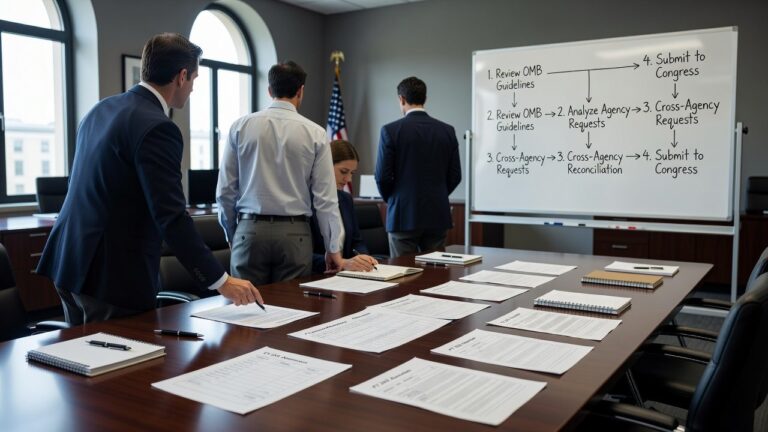
Following the federal budget process demands a methodical approach to timelines and documents, especially when those allocations shape voter priorities heading into midterms and presidential contests. The cycle established by the Congressional Budget and Impoundment Control Act of 1974 begins in February with the president’s submission, setting the stage for negotiations that frequently surface in polling on economic confidence and government priorities. Historical patterns show budget standoffs correlating with shifts in approval ratings, particularly in swing districts where defense and social spending debates cut across demographic lines.
The president’s budget, prepared by the Office of Management and Budget, outlines discretionary requests, mandatory funding, and revenue estimates for the fiscal year starting October 1. When you model this electorally, these proposals often test partisan coalitions, with recent data indicating varying support by income and age cohorts in national surveys. Budget committees then conduct hearings, providing early signals that analysts track against primary-election polling margins in key states.
Understanding the mechanics of budget language itself proves invaluable for anyone serious about tracking proposals. Terms like “authorization” versus “appropriation” carry distinct meanings: an authorization establishes a program and sets a ceiling on spending, while an appropriation actually provides the funds. Many programs operate under expired authorizations for years, continuing through annual appropriations riders. The distinction matters because it reveals where Congress prioritizes and where dysfunction persists. A tracked authorization bill that stalls in committee signals potential vulnerability in a particular agency’s mission or political support base.
Congress targets April 15 for a budget resolution establishing spending caps and revenue goals, though this non-binding measure frequently slips in divided government. The polling data here paints a complicated picture, as breakdowns by education level and region reveal inconsistent voter tolerance for across-the-board caps versus targeted adjustments. Appropriations committees advance the twelve annual bills, and monitoring their markups offers insight into how line-item changes might register in generic-ballot trends or issue-specific surveys.
The twelve regular appropriations bills correspond to broad functional areas: agriculture, commerce-justice-science, defense, energy-water development, financial services, homeland security, interior-environment, labor-health and human services, legislative branch, state-foreign operations, transportation-housing, and veterans-military construction. Tracking bills by category allows observers to identify which agencies gain or lose influence during a given cycle. For instance, shifts in the Department of Homeland Security’s budget relative to the State Department often reflect changing congressional priorities on border security versus diplomatic engagement—issues that resonate differently in different voter demographics and regional markets.
Appropriations markup sessions, typically held in late spring and summer, represent crucial observation points. These committee meetings, open to the public and sometimes livestreamed, showcase real-time negotiations over specific line items. A legislator’s amendments—whether successful or defeated—reveal their district’s priorities and their negotiating power. Tracking who introduces amendments, who speaks in support or opposition, and the vote tallies creates a granular picture unavailable in final bills alone. Markup documents often appear on House and Senate Appropriations Committee websites within days, though some historical records require filing Freedom of Information Act requests.
Primary sources remain essential. The White House posts the full request, the Congressional Budget Office supplies independent estimates, and Congress.gov catalogs bills and amendments. Cross-referencing these with reports from the Government Accountability Office and Congressional Research Service yields balanced comparisons free of framing, much as one would layer multiple pollsters to assess sampling error in a tight race.
The Congressional Budget Office deserves particular attention for its scoring methodology. When Congress passes legislation affecting the budget, the CBO provides official cost estimates—critical documents that shape how legislators vote and how the public understands spending implications. The CBO’s ten-year budget projections, updated multiple times annually, form the baseline against which all deficit discussions unfold. These projections include detailed economic assumptions and footnotes explaining methodological choices, offering transparency into how budget math is constructed. Comparing CBO estimates across time reveals how economic forecasts shift and how policy changes accumulate.
Specialized dashboards from groups like the Committee for a Responsible Federal Budget allow filtering by agency and function, aiding comparisons to prior cycles. When overlaid with historical election data, such as the four instances since 1977 when all appropriations cleared on schedule, these tools highlight how delays have occasionally amplified turnout among independents wary of fiscal gridlock. Additional resources include USAspending.gov, a Treasury Department platform that tracks federal outlays in near real-time, allowing citizen observers to follow how allocated dollars flow to specific recipients, contractors, and geographic regions.
Fiscal year 2025 proposals reached roughly $6.9 trillion in outlays, with discretionary spending near 30 percent and mandatory programs near 60 percent. Defense alone exceeded $800 billion, while sequestration under the 2011 Budget Control Act trimmed growth by an estimated $1.5 trillion over nine years. The Congressional Budget Office has issued more than 1,200 cost estimates tied to resolutions since 2010. Demographic polling on these categories consistently shows older cohorts prioritizing entitlements and younger groups more open to infrastructure reallocations, patterns that map unevenly across battleground states.
The reconciliation process, available once per fiscal year under the Congressional Budget Act, merits special attention from budget trackers. Reconciliation bills require only a simple majority in the Senate, bypassing the filibuster, making them potent vehicles for major tax and spending changes. Recent examples include the 2017 Tax Cuts and Jobs Act, the 2021 American Rescue Plan, and the 2022 Inflation Reduction Act. Identifying whether proposals are being advanced through reconciliation versus regular order signals their likelihood of passage and the partisan intensity surrounding them. Budget committees must formally designate reconciliation instructions, typically within the spring budget resolution, so watching for these instructions provides early warning of major legislative pushes.
Continuing resolutions—stopgap measures that extend prior-year funding when Congress fails to enact regular appropriations—have become increasingly common, occurring in most recent fiscal years. A continuing resolution freezes most agencies at previous spending levels, preventing new initiatives or reductions. Tracking continuing resolution language reveals which provisions Congress intends to carry forward and which it plans to revisit, offering insight into emerging disputes likely to surface in future negotiations.
Engaging committee alerts and congressional records, alongside expert commentary, creates a monitoring framework that connects spending decisions to electoral outcomes without relying on secondary narratives. Setting up notifications from Congress.gov for bills in tracked committees, subscribing to CBO release notifications, and following appropriations committee social media accounts or press releases ensures you capture information as it becomes public. Additionally, attending town halls where representatives discuss budget votes or requesting constituent meetings to discuss budget priorities creates direct channels for understanding how legislators justify their positions to voters—information valuable for anyone seeking to understand both the substantive content and the political messaging surrounding federal spending.
Sources
- Reuters Politics – Breaking news and analysis on U.S. political developments
- AP News U.S. Politics – Current coverage of federal legislation and budget matters
- NPR Politics – In-depth reporting on Congress and federal policy
- Politico Budget – Comprehensive coverage of federal spending proposals and debates
- Congress.gov – Official resource for tracking bills and budget resolutions