
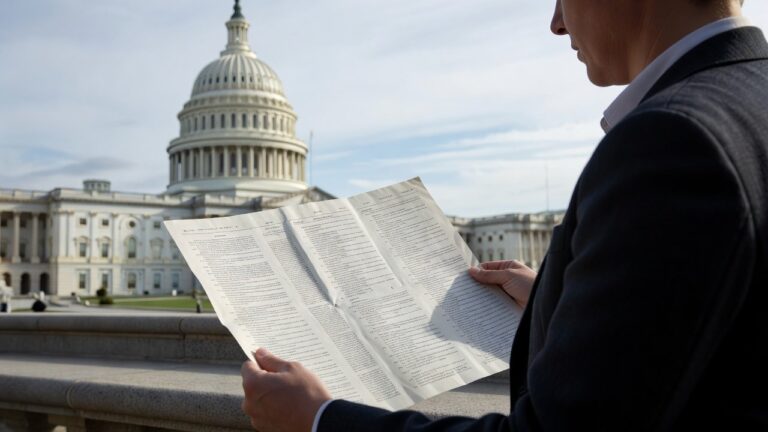
Understanding congressional bill text is essential for tracking how legislation translates into electoral outcomes across battleground states and districts. The standardized structure that every bill follows—starting with a short title, enacting clause, and then sections on findings, purposes, and operative provisions—offers analysts a reliable framework for assessing which policies might resonate with specific voter blocs in upcoming cycles.
Bills often segment into titles and subtitles that target distinct policy domains, much like an infrastructure package separating highways from transit and water systems. Scanning these divisions reveals where appropriations or regulatory shifts land, which in turn shapes polling on economic priorities in Rust Belt counties or Sun Belt suburbs. The enacting clause itself, declaring “Be it enacted by the Senate and House of Representatives of the United States of America in Congress assembled,” anchors the measure’s legal force and can become a talking point when campaigns frame gridlock or achievement narratives.
Findings and purposes clauses, though non-binding, surface early to justify the legislation with statistics or prior statutes. These passages frequently preview how lawmakers intend to court particular demographics, whether suburban independents or rural working-class voters, and historical patterns show that such language often foreshadows messaging tested in midterm or presidential surveys.
Legal terminology carries predictable weight: “shall” imposes mandates, “may” allows flexibility, and “notwithstanding any other provision of law” overrides earlier statutes, a maneuver common in defense or spending measures. Internal definitions matter just as much; redefining “small business” can shift eligibility for credits and alter economic perceptions among self-employed voters in swing districts. Cross-referencing these terms against existing code prevents misreading ripple effects that later surface in approval ratings.
Amendments in committee and on the floor add further layers. Comparing introduced versions against enrolled bills via Congress.gov highlights compromises, and tracking manager’s amendments—which now affect over 60 percent of major legislation—helps model how last-minute changes might play in key states. Delayed effective dates and required agency rulemaking mean many provisions do not hit immediately, a detail that matters when forecasting voter reactions timed to election calendars.
Riders attached to must-pass bills expand scope beyond the original title, a tactic that historically complicates messaging for both parties. With more than 10,000 bills introduced each Congress yet fewer than 5 percent enacted, and average length ballooning from roughly 20 pages in the 1970s to over 200 today, the volume alone demands disciplined reading. Appropriations alone direct nearly $1.7 trillion in discretionary spending, directly influencing which demographic cohorts feel the impact in time for the next round of polling.
The Congressional Research Service and Government Publishing Office supply summaries and cost estimates that pair usefully with raw text. When you model this electorally, the ability to parse these documents clarifies how congressional output feeds into White House strategy and voter coalitions without relying on secondary spin. Congress.gov itself draws more than 50 million visits annually, underscoring sustained public interest in following the process that ultimately determines which policies reach the electoral map.
One practical starting point is the bill summary itself, located at the top of every Congress.gov entry. These summaries, often written by the Congressional Research Service, condense legislative intent into digestible language. However, summaries can mask contentious details buried deeper in the text, so they should anchor rather than replace direct reading. A bill’s CRS summary might highlight workforce development funding while omitting sunset provisions or state-by-state funding formulas that reshape the actual impact. Comparing the summary language against at least the first few operative sections provides a reality check on what the measure genuinely accomplishes versus how sponsors market it.
Bill numbers themselves follow a logical pattern worth understanding. House bills begin with “H.R.” and Senate bills with “S.” The number sequence reflects introduction order within each chamber during a given Congress. When tracking a bill’s journey, noting that H.R. 1234 and S. 5678 address similar topics helps identify companion bills—parallel measures advancing through each chamber simultaneously. During negotiations, one chamber’s version often absorbs amendments from the other, and the final compromise bill typically takes the House number if it originates there, creating a paper trail visible through version comparison on Congress.gov.
Effective date provisions deserve close attention because they determine when voters and affected stakeholders actually experience a law’s impact. Some bills take effect upon presidential signature; others include delayed implementation dates spread across years. Tax legislation frequently stacks effective dates strategically—tax cuts might begin immediately while revenue-raising provisions start later, a sequencing that shapes public perception and campaign narratives. Similarly, agency rulemaking deadlines written into statute mean that the full policy framework may not crystallize until 12 to 24 months after enactment, well after electoral dust settles.
Sunset clauses, which automatically terminate programs unless Congress reauthorizes them, represent another layer of political calculation. Defense spending measures, welfare programs, and tax provisions often include sunset dates that force congressional action during future election cycles. Understanding when major provisions expire helps explain why certain bills resurface regularly; they are not new legislation but rather expiring measures being renewed. This pattern particularly affects tax law, where numerous provisions require regular reauthorization, keeping tax reform constantly in Congress’s sightseeing.
Appropriations bills merit special examination because they structure federal spending across agencies and programs. Unlike authorization bills that establish programs, appropriations bills fund them, and the two often diverge. A bill might authorize spending for a particular initiative while the appropriations process determines whether and how much money actually reaches it. Reading an appropriations bill involves tracking line items by agency, then by subagency or program, a granular exercise that reveals federal resource allocation and consequently which districts and states receive federal dollars.
Cross-references within bill text can seem tedious but are essential for accuracy. Bills routinely amend existing statutes by inserting language into specific sections of the U.S. Code or preceding legislation. The phrase “insert after section 123 the following new section” requires readers to understand what section 123 says currently to grasp what the new section will do. Committee reports, available on Congress.gov alongside bill text, often explain these amendments in clearer language, making reports a valuable supplement for understanding complex statutory changes.
Table of contents sections, present in many longer bills, provide a roadmap that helps readers prioritize. A 200-page bill often contains numerous titles addressing separate policy areas. Skipping to relevant titles saves time while ensuring you are not missing a critical provision hidden between major sections. Many bills, especially omnibus measures, read like collections of separate bills stitched together, so understanding the structure prevents missing policies that do not obviously belong in the legislation you thought you were reading.
Fiscal notes and cost estimates, typically generated by the Congressional Budget Office or CRS, quantify the bill’s financial impact. These estimates indicate how much a bill will add to deficits or surpluses and which revenue streams or spending categories it affects. Cost estimates sometimes prove contentious because they rest on assumptions about implementation, inflation, and economic growth. Tracking disagreement between CBO estimates and other analyses reveals areas where uncertainty or partisan dispute clouded the bill’s likely effects, information valuable for understanding its genuine fiscal footprint.
Finally, keeping a simple reading log—noting the bill number, key provisions, effective dates, and definitions—helps organize findings and enables quick reference during future analysis. As bills grow longer and more complex, systematic note-taking prevents misremembering details that may matter months later when a provision actually takes effect or becomes relevant to voter reactions in key districts.
Sources
- Congress.gov – Official Help and FAQ on bill text and legislative process
- AP News – Associated Press coverage of US legislative affairs
- Reuters Politics – US congressional and legislative reporting
- Politico – Daily coverage and guides to understanding Congress
- NPR Politics – National Public Radio legislative analysis and explainers