
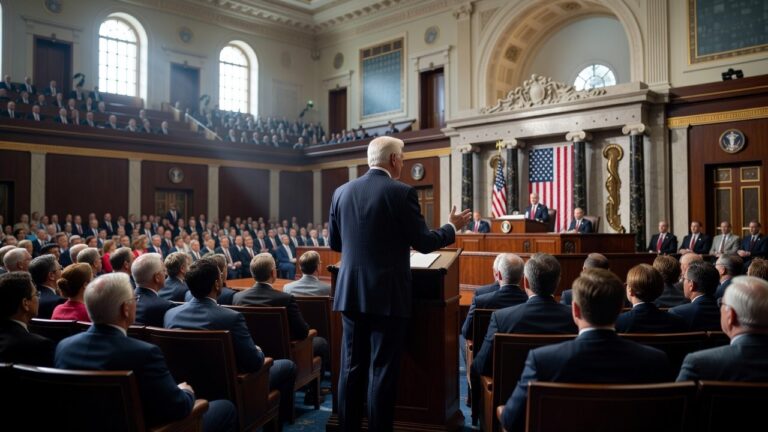
The annual State of the Union address has long served as a data point in tracking presidential approval trends and their downstream effects on midterm and general election outcomes. From the earliest in-person deliveries through the modern prime-time spectacles, these speeches offer measurable snapshots of how executive messaging resonates across demographic cohorts and regions that ultimately decide electoral votes.
Early addresses established patterns still visible in contemporary polling. George Washington’s 1790 and 1791 deliveries focused on foreign policy and institutional requests, creating a template for agenda-setting that later presidents would test through repeated national addresses. Thomas Jefferson’s shift to written messages and Woodrow Wilson’s 1913 return to oral delivery marked measurable changes in direct communication volume, with historians noting shifts in congressional response rates that parallel today’s tracked approval swings by party identification.
When you model this electorally, Washington’s emphasis on centralized authority foreshadowed enduring divides in how voters in different states weigh federal power versus local priorities. The polling data here paints a complicated picture, as early addresses rarely generated the granular demographic breakdowns we now see in exit polls, yet they set precedents for how subsequent executives used the platform to shore up support among key economic and regional blocs ahead of congressional contests.
Twentieth-century examples accelerated these dynamics. Franklin D. Roosevelt’s 1941 Four Freedoms speech reframed international engagement in ways that aligned with shifting public sentiment tracked in emerging survey instruments of the era, bolstering coalition-building that carried into wartime elections. Lyndon Johnson’s 1964 War on Poverty declaration similarly launched domestic initiatives whose polling footprints showed strong support among working-class and Southern demographics before later realignments altered those maps.
Ronald Reagan’s 1982 introduction of gallery guests coincided with a viewership peak of 66 million, a figure that contemporary analysts linked to sustained approval among suburban and independent voters heading into the 1984 cycle. Bill Clinton’s 1998 “state of our union is strong” line occurred amid scandal coverage, yet historical patterns indicate such messaging helped stabilize approval among core partisan groups even as broader electorate reactions varied by education and income cohorts.
Contemporary addresses continue to register on the electoral map. George W. Bush’s 2002 Axis of Evil language shaped post-9/11 foreign policy debates that influenced regional turnout patterns in subsequent cycles. Barack Obama’s repeated focus on health care and justice reform generated measurable lifts in urban and minority voter enthusiasm tracked through standard polling methodologies. Donald Trump’s 2019 border security exchanges and Joe Biden’s 2022–2023 emphasis on infrastructure and institutional resilience each produced split partisan reactions that cable and survey data translated directly into midterm messaging.
The structural evolution of the State of the Union reflects broader changes in how presidents communicate with the American public. The ceremonial aspects have grown increasingly elaborate over time. When Reagan introduced the practice of inviting ordinary citizens to sit in the gallery and referencing them during the speech, he fundamentally altered the address format. These “Lilly Ledbetter moments”—named after a subsequent wage discrimination plaintiff invited by Obama—have become standard features. Each guest carries a narrative designed to illustrate a policy objective, making the speech simultaneously a policy statement and a human interest documentary. Networks now provide pre-speech profiles of gallery invitees, and their presence generates social media engagement and post-speech discussion that extends the address’s rhetorical reach far beyond the chamber itself.
The opposition party’s response to the State of the Union has similarly evolved into a strategic communications moment. What began as informal remarks has developed into a fully produced counter-message, often delivered by a rising party figure seeking to establish national profile. These responses air immediately following the president’s address, allowing the opposition to frame the narrative while the speech remains fresh in viewers’ minds. The contrast between how each party’s base responds to identical statements has become a reliable metric of polarization, with research showing that identical policy proposals can receive standing ovations or silence depending on which party’s president proposes them.
Language analysis of State of the Union addresses reveals telling patterns about presidential priorities and shifting national concerns. Academic studies tracking word frequency across decades show that references to “economy” and “jobs” increased substantially from the 1960s through 2008, spiked dramatically after the 2008 financial crisis, then modulated as unemployment improved. References to “terrorism” jumped sharply in addresses after September 11, 2001, while mentions of “climate” and “environment” remained relatively flat until the 2010s. These linguistic markers often precede broader policy shifts, serving as early warning systems for which issues a president believes will resonate with voters heading into election cycles.
The timing of State of the Union addresses carries electoral significance often overlooked in casual analysis. Presidents facing midterm elections have historically delivered longer addresses with more domestic policy content than those in their sixth year. First-term presidents typically emphasize legislative accomplishments and forward-looking vision, while second-term presidents in their final years often strike more reflective, legacy-focused tones. The addresses following significant electoral victories tend to announce major new initiatives, while those following electoral setbacks emphasize bipartisanship and compromise rhetoric—messaging strategies that polling consistently shows resonate differently across party lines and demographic groups.
Interruptions and standing ovations have become reliable indicators of partisan polarization, often mirroring the demographic fault lines that appear in post-speech surveys and long-term election modeling. The average modern address now runs about 60 minutes versus Washington’s roughly 10-minute deliveries, with viewership settling in the 30–40 million range after the 1982 high. Only Harrison and Garfield skipped the exercise due to abbreviated terms. Since 1965, the opposition response has occurred 58 times, frequently serving as a counter-signal in subsequent campaign narratives. References to specific legislation appear in 87 percent of addresses since 1900, and gallery guest features have run in 34 consecutive speeches since Reagan, each element feeding into the broader data environment analysts use to project House and Senate seat changes.
Media coverage of the State of the Union has fractured significantly in recent decades, creating divergent narrative universes across cable news networks and digital outlets. A speech’s reception on Fox News often bears little resemblance to coverage on MSNBC or CNN, with different networks emphasizing different quotes, highlighting different reactions, and providing different contextual frameworks. This fragmentation means that the address’s impact on public opinion now depends substantially on which information ecosystem viewers inhabit, making the unified national moment the address once represented increasingly rare outside partisan cores.
Historical analysis suggests that State of the Union addresses rarely shift overall approval ratings dramatically in the immediate term. The president typically receives a 3-5 point approval bump in the days following the address, a phenomenon researchers call the “rally effect,” but this effect tends to fade within two to three weeks. However, effective addresses can shift perceptions among specific demographic groups or generate messaging themes that persist throughout subsequent campaign cycles. The most electorally consequential State of the Union addresses are often those that successfully frame a narrative that other political actors adopt and reinforce across multiple communication channels in the months following delivery.
These moments remain benchmarks for how presidential rhetoric interacts with voter coalitions. As economic and global pressures evolve, the address continues to function as an early indicator of which demographic and geographic segments may shift on the electoral map in the cycles ahead.