
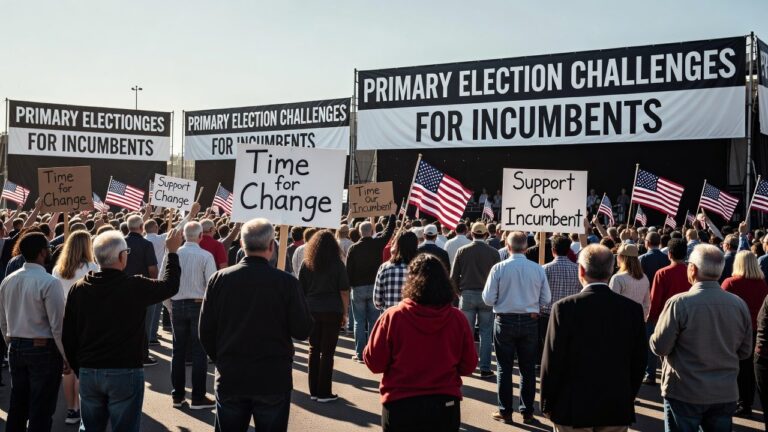

Primary challenges have become a more persistent feature of the congressional landscape in recent cycles, with both parties seeing incumbents tested by activists who prioritize ideological consistency over institutional experience. When you model this electorally, the impact shows up most clearly in districts where redistricting has shifted the underlying partisan balance, creating new voter coalitions that pollsters must re-sample using updated voter files and turnout models calibrated to low-propensity primary participants.
The polling data here paints a complicated picture. Historical patterns from 2010 through 2022 show that incumbent reelection rates in congressional primaries have averaged above 90 percent, yet that figure drops sharply once serious, well-funded challengers enter the race. Methodology matters: many early-cycle surveys rely on likely-voter screens that overweight older and more engaged demographics, which tend to be the same groups driving primary turnout that typically ranges between 15 and 25 percent of registered voters. Demographic breakdowns consistently reveal that these voters skew more ideologically intense than the general electorate, amplifying the influence of outside spending groups that have increased more than tenfold since 2010.
Understanding who actually votes in primaries is essential to grasping why incumbents face unexpected vulnerability. Primary electorates differ markedly from general-election voters in both composition and priorities. Older voters, particularly those over 65, represent a disproportionate share of primary participants across both parties. College-educated voters and those with higher household incomes also turn out at elevated rates. Meanwhile, younger voters, Hispanic voters, and those without college degrees show up in lower numbers during primaries compared to November elections. This structural reality means that candidates capable of exciting core party activists—those most likely to vote in low-turnout contests—can outperform candidates focused on broader coalition-building, even when those broader coalitions would be more competitive in general elections.
Redistricting after the 2020 census added another layer, placing dozens of incumbents into unfamiliar terrain and prompting higher retirement rates as they assessed new primary risks. On the Republican side, challenges often focus on fiscal and immigration records; on the Democratic side, climate and criminal-justice positions draw the most heat. Both dynamics reward candidates who can mobilize narrow but highly motivated factions, frequently backed by national super PACs or prominent endorsers who double the win rate for their chosen contenders.
The mechanics of primary challenges reveal how endorsements function as powerful multipliers in low-information environments. When a prominent national figure—whether a former president, major media personality, or respected legislator—endorses a challenger, it provides crucial credibility signaling to primary voters who may have limited familiarity with candidates outside the incumbent. Research on past primary cycles shows that endorsements from figures with strong name recognition can increase a challenger’s vote share by five to ten percentage points, a margin that often proves decisive in crowded primary fields. This dynamic has intensified as partisan media ecosystems have allowed endorsers to reach targeted audiences more efficiently, concentrating their impact among the most engaged voters.
Campaign finance dynamics in primary races deserve particular attention, as they diverge significantly from general-election patterns. Super PACs and outside spending groups can operate with minimal coordination, allowing multiple groups to target the same incumbent simultaneously. A challenger facing a well-known incumbent may attract support from several independent expenditure committees, each running separate media campaigns that collectively outspend the incumbent’s own advertising. This fragmented spending landscape makes it difficult for incumbents to anticipate and respond to the full scope of opposition messaging, particularly when challenges emerge from multiple ideological directions within the same primary.
Fundraising patterns underscore the pressure. Incumbents facing opposition raise roughly 40 percent more than those running unopposed, diverting resources that might otherwise target general-election swing voters. When you look at the electoral map, this resource drain can weaken nominees in districts that lean only modestly toward one party, where bipartisan legislative records once provided a buffer. The calculus becomes particularly acute in swing districts where the general-election margin is expected to be narrow; resources spent defending against primary challengers in July cannot be redeployed to persuade independent voters in October.
The relationship between primary challenges and legislative voting patterns offers another lens for understanding incumbent vulnerability. Scholars tracking congressional roll-call votes have documented that voting records have become increasingly polarized, with fewer opportunities for genuine bipartisan coalition-building. This creates a perverse dynamic: incumbents who maintain moderate voting records in hopes of appealing to swing voters may face intense primary criticism from activists who view compromise as betrayal. Conversely, those who vote with their party base consistently may struggle in general elections if their district has shifted demographically or ideologically. Finding the balance between these competing pressures has become one of the central strategic challenges of modern congressional service.
Successful incumbents adapt by investing early in internal polling that tests message resilience across demographic subgroups and by leaning on constituent-service data that resonates even in low-turnout environments. Those who survive often emphasize legislative wins that bridge national party priorities with local economic concerns, preserving broader coalitions against purity-driven opponents. Early investment in voter contact—whether through town halls, direct mail, or digital advertising—helps establish name recognition and positive impression among primary voters before challengers gain traction. Incumbent advantages in constituent services remain powerful: voters who have received assistance from their representative’s office on issues ranging from Social Security benefits to immigration cases demonstrate significantly higher incumbent support in primary matchups.
The geographic concentration of primary challenges also warrants examination. Certain districts see repeated incumbent challenges while others rarely do, suggesting that structural and demographic factors beyond individual candidate quality shape primary competitiveness. Districts with rapid demographic change, particularly those experiencing significant population growth or shifts in educational composition, generate higher primary challenge rates. Similarly, districts where the incumbent’s party enjoys substantial registration advantages tend to produce more primary competition, since the primary becomes the effective general election and thus attracts multiple candidates betting they can assemble a winning coalition within the party base.
As these trends continue, the composition of the next Congress will hinge less on general-election fundamentals alone and more on which incumbents accurately read the primary electorate’s shifting demographics and turnout behavior. Understanding these dynamics requires attention to granular data about who votes, when they vote, what messages move them, and how their priorities diverge from the broader electorate. Campaigns that master this data-driven approach to primary politics gain substantial advantages in navigating an electoral environment where ideological intensity has become a more reliable predictor of primary victory than broader popularity or legislative accomplishment.
Sources
- Reuters Politics – Breaking news and analysis on U.S. political campaigns and elections
- AP News Elections Hub – Comprehensive coverage of primary elections and incumbent challenges
- NPR Politics – In-depth reporting on primary election dynamics and political trends
- Politico Election Results – Real-time primary election data and incumbent performance analysis